
Table of Contents
A transformation years in the making – not an overnight miracle
The story of Greater Manchester’s revival is often misread as a sudden success driven by a single mayor or a burst of city-centre investment. In reality, it is the product of three decades of Labour-led municipal pragmatism, forged in conditions of managed decline and chronic centralisation.
From the mid-1990s, Labour councils across the ten boroughs of Greater Manchester pursued regeneration with limited fiscal and political tools. The rebuilding after the 1996 IRA bombing, the strategic use of culture and sport, and the 2002 Commonwealth Games laid essential physical foundations. Yet growth remained fragile, uneven and overly dependent on property development, because real power still sat in Whitehall.
This long pre-history matters. It explains why devolution in Greater Manchester was never about ideology. It was about necessity.
From Devo Manc to a functioning system of power
The decisive shift came with Devo Manc: the creation of the Greater Manchester Combined Authority and the first meaningful English devolution settlement outside London. It reflected a shared conclusion across Labour local government that Westminster governance had failed to close gaps in productivity, health and opportunity.
Pooling sovereignty locally was not radical experimentation. It was a practical response to a deeply centralised state that repeatedly promised “rebalancing” while entrenching regional inequality.
When Andy Burnham was elected Mayor in 2017, he inherited a partially built system. The powers existed on paper. What was missing was political direction and the willingness to use them.
What Burnham changed: power exercised, not merely possessed
Burnham’s mayoralty is best understood less as a catalogue of announcements and more as a shift in governing culture. His approach has been consistent: visible accountability, moral clarity and a readiness to confront national government where local interests are at stake.
This matters because English devolution has often failed not for lack of powers, but for lack of political confidence in using them.
Transport reform and the Bee Network
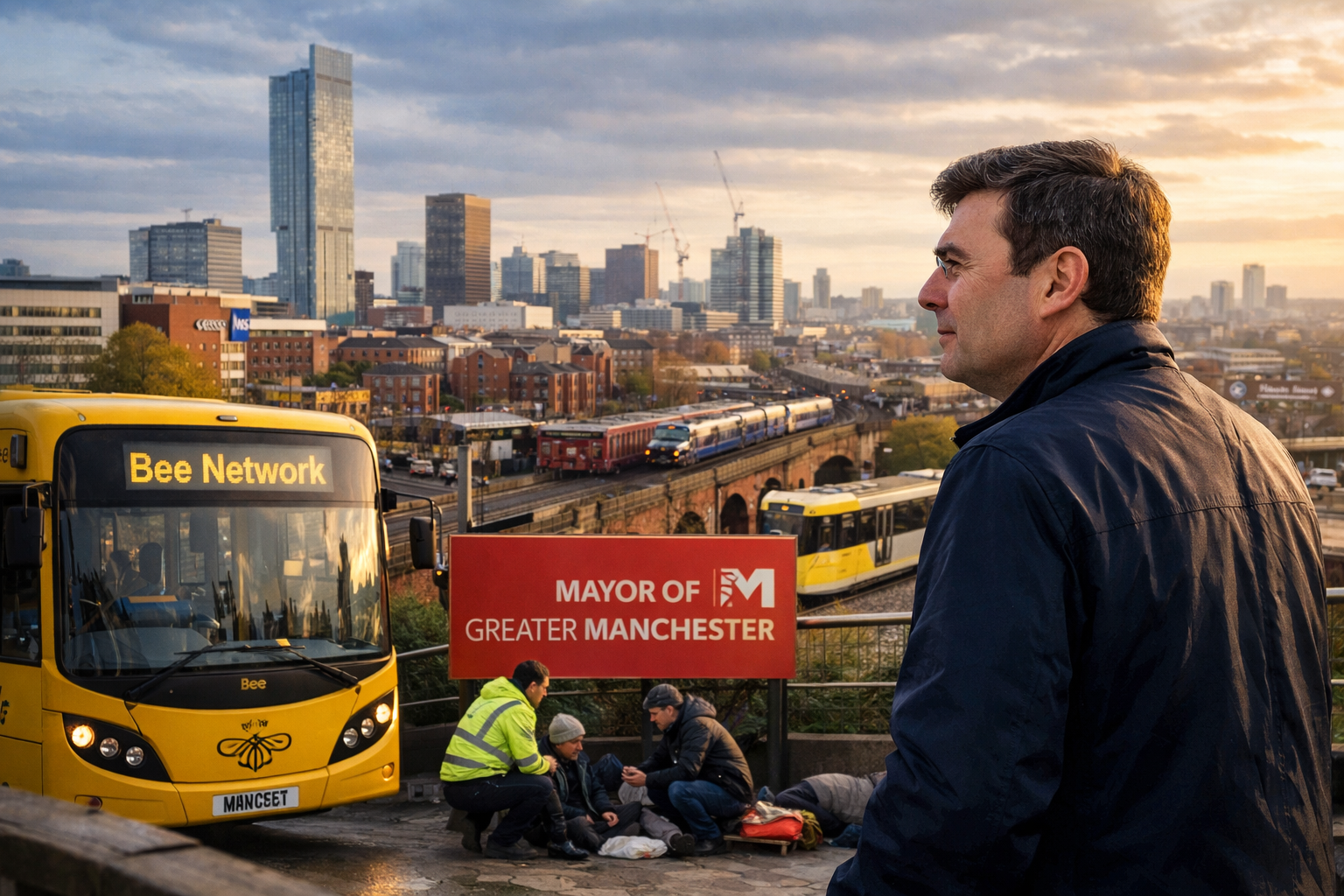
The most tangible expression of Devo Manc Labour governance is transport reform. Bus franchising and the creation of the Bee Network reversed decades of deregulation that left passengers with high fares, unreliable services and no democratic control.
Under Labour leadership, Greater Manchester did something rare in English politics: it used powers that already existed.
The Bee Network is not a cosmetic rebrand. It represents:
- Local control over routes, fares and service standards
- Integrated ticketing across buses and trams
- A pathway towards rail integration and a genuinely unified system
This is not nostalgia for municipal ownership. It is an assertion of state capacity. In a political climate defined by low trust, visible improvements in daily life matter more than abstract reform.
Homelessness: refusing to manage injustice quietly
Homelessness policy most clearly distinguishes Greater Manchester’s Labour approach from Westminster orthodoxy. Instead of managing eligibility thresholds and displacement, the mayoral authority introduced A Bed Every Night and expanded Housing First.
The principle was straightforward: rough sleeping is a systemic failure, not an individual moral one.
No local authority can “solve” homelessness while housing supply, welfare rules and mental health funding remain nationally constrained. But Greater Manchester changed the frame of debate. Homelessness became a policy responsibility to be addressed openly, rather than an inconvenience to be obscured.
Health, prevention and the limits of an NHS-only mindset
Burnham’s Live Well agenda reflects a wider understanding of inequality in the North. Poor health outcomes in Greater Manchester are not primarily a failure of hospitals. They are the product of insecure work, poor housing, debt, isolation and environmental stress.
By linking councils, the NHS, voluntary organisations and neighbourhood services, Greater Manchester is attempting something Westminster frequently promises and rarely funds: prevention at scale.
This matters because Britain’s health inequality crisis will not be resolved by waiting lists alone.
Labour values translated into governance
Greater Manchester illustrates what Labour values look like when applied to real systems rather than slogans:
- Public control where markets have failed
- Universalism over exclusion
- Prevention rather than crisis management
- Place-based decision-making grounded in lived experience
This is not romantic municipal socialism. It is applied social democracy under constraint.
The North’s long injustice – and why devolution was inevitable
Understanding the resonance of Devo Manc Labour governance requires confronting the structural injustices faced by northern regions.
Chronic underinvestment
For decades, Treasury appraisal rules favoured already-successful regions. London consistently received far higher per-capita transport investment, while northern cities were told to improve productivity without the infrastructure required to do so.
Deep health inequalities
Healthy life expectancy in parts of Greater Manchester lags years behind affluent areas of southern England. This is not cultural preference; it is the cumulative effect of structural disadvantage.
Broken national promises
The cancellation of the northern leg of HS2 crystallised northern mistrust. Years of planning were abandoned with minimal regard for regional impact. Burnham’s opposition was not theatrical. It reflected institutional memory.
Where the Greater Manchester model still falls short
A serious assessment must acknowledge limitations:
- Regeneration benefits remain uneven between the city centre and outer towns
- Housing affordability and quality remain nationally constrained
- Fiscal dependence leaves local leaders accountable without full control
- Devolution complicates accountability by concentrating blame at mayoral level
These are not local failures. They are the predictable outcomes of partial devolution.
What Greater Manchester teaches Labour nationally
The lesson of Devo Manc is not to replicate personalities, but to change structures. Effective Labour governance requires:
- Power closer to communities, matched with resources
- Integrated public services rather than departmental silos
- Investment rules that support lagging regions
- Leadership judged by delivery, not messaging
Greater Manchester demonstrates that this approach is viable. It also explains why Westminster resists it.
Conclusion: why Andy Burnham matters
Without endorsing individuals, one conclusion is unavoidable. Governing a complex region under constraint is a more rigorous test of leadership than managing narratives from the centre.
Greater Manchester shows a model of Labour governance that is pragmatic, socially just and delivery-focused. It is not a sideshow. It is the closest thing Britain currently has to a functioning alternative.
The real question for national Labour is not whether it praises Devo Manc, but whether it is prepared to learn from it.
References
- Greater Manchester Combined Authority, Devolution Agreement Documentation
- Institute for Fiscal Studies, Regional Inequality and Public Investment
- NHS England, Integrated Care and Prevention Models
- Ministry of Housing, Communities & Local Government, Homelessness Policy Reviews